Friday, April 29, 2016

Week 6: Underground Comics


        For this week I read Tijuana Bible, which can easily be described as a pornographic comic. It is a compilation of several stories and styles, some are parodies of existing intellectual property. There was one in particular that imitated Mickey Mouse but the story itself was adult content. At the time that this comic came out it was not the type of content allowed to be sold. People were arrested over distributing the Tijuana Bible.
      This comic seemed like the early version of "Rule 34" to me. Rule 34 is an internet meme that basically means that there is porn out there for any conceivable subject. Literally anything you can think of - somewhere out there on the internet there is sexually explicit content of it. This is why you must always Google Image search carefully.
       I think that the fascination with pornography in comics is because of how people relate to comics. When reading a story people like to be able to relate to characters, and a big part of being human(and making sure our race doesn't die out) is sex. Although reading this comic made me very uncomfortable, comic books of this nature are not going away any time soon.

Tuesday, April 26, 2016

Week 13 -The Authority


Are there any prominent symbols in the story? If so, what are they and how are they used?

There is a physical symbol of the Gamorra brothers, a ring with 3 knots. The villain Kaizen has this symbol on all of the men/creatures in his army. He is basing his plot for world domination on his symbol by taking out 3 prominent cities. Kaizen killed his two brothers, and it reflects in the symbol because one knot is set apart from the other two. The ring with 3 knots represents everything to do with Kaizen.

What connections did you make with the story? Discuss the elements of the work with which you were able to connect.

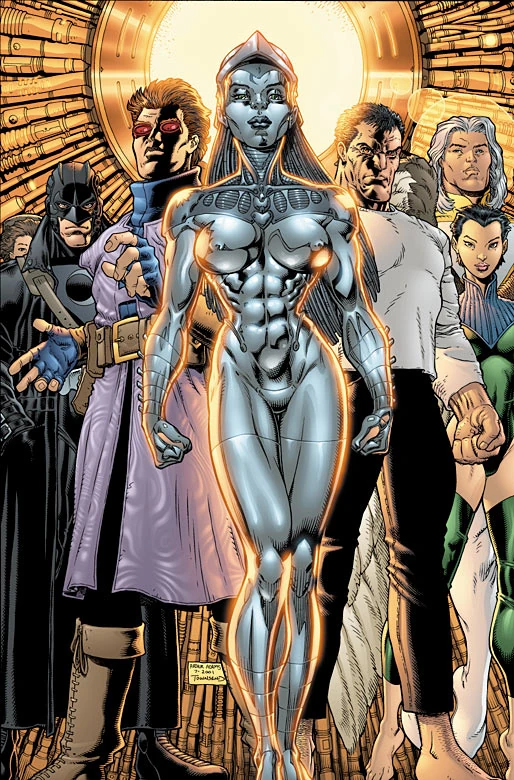
The Authority is a piece about a large superhero team that I believe is referred to as "Skywatch", it is hinted that another team called "Stormwatch" previously existed but the majority of the team died or disbanded a while ago. I had a hard time not relating the characters to those of the Justice League. There is a hawk girl on both, a dark brooding character looking a lot like Batman, and the character Apollo reminds me a lot of Superman. It's hard to have a large ensemble with characters that differentiate from other works with a large ensemble.

What changes would you make to adapt this story into another medium? What medium would you use? What changes would you make?

If I were to adapt this story, I would take a little more time to introduce the super team. There are a lot of characters and it's very difficult to relate to them or get to know them at all. I would adapt this either into a television series in the style of Game of Thrones, or a video game where you could play as the different characters and really get to know them. The Authority in my opinion needs to start off with less characters and develop them before bringing in the whole team.

Monday, February 22, 2016

The Emergence of the Graphic Novel


            For the “Emergence of Graphic Novels” I read The Spirit #2 by Eisner. Not even halfway through the first page is a very racist depiction of an African American that is only made worse when he is named Ebony. I know that was kind of a product of the time, but it certainly is hard to look at and read now.
            Aside from the extremely racist depiction of an African American man, I do like the art style in this comic. I think they do a good job of pushing the caricature while still making them believable as people in the real world. The poses and movements are pushed, but not to the point of “rubber hose” style. All and all I can tell these are cartoons, but I know exactly what these characters would look like in real life. There is quite a bit of appeal to that.
            When I read the title for this week, I expected something closer to a graphic novel. The first section lasts 7 pages- about the length of a comic book, and then is immediately interrupted by an unrelated comic. I would not say that this is a graphic novel, since there aren’t really chapters. To me this seems more like a hodge-podge of comic books compiled together.

            It’s really unfortunate that the first character you see is just an extremely racist one. While they did caricature everyone, nobody’s features were pushed as far as Ebony’s and nobody spoke with a dialect except for Ebony. For a person alive in 2016 it is a major turn off to see that and I immediately lost all interest in the comic.

History of the Comic Book

             This was an interesting week looking at some early comic books. I looked at Ducktales and this was deeply contrasted by an action comic I read which I believe was The Punisher. The first was wholesome family fun with appealing Disney characters; the latter was realistic, gritty, and full of violence. Both types of stories have their place in society.
            As I was saying Ducktales is wholesome family fun. It was full of characters that were cartoony and far from reality. The conflicts in the stories were never anything huge  - in one McScrooge dreamt he gave away his money and woke up glad that he did not and could still go swimming in his piles of money. They were cartoons that did cartoony things. It was a goofy world that lived in the imaginations of it’s readers and brought joy and entertainment to it’s audiences.
            The more action-oriented comics were successful because of their “realism”. The characters looked more like they belonged in our world and the story lines were more relatable to real life. These comics began to include more adult topics and graphic violence. Because of the intensity of these stories, the cliffhangers raised anticipation and desire for the next issue. People who like drama or action were more drawn to these types of comic books.
            Both types of comic have their audience, which usually overlaps. I’m a fan of both and depending on what is going on in my life I will gravitate towards one or the other. I love intense storylines, but sometimes it is nice to read something light and fluffy. Other times I want content and I want to go on an emotional rollercoaster with fictional characters. I like both.

The Comic Strip

   
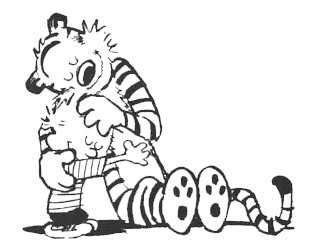
     For this week I chose to read Calvin and Hobbes by Bill Watterson. For many people this is a comic they grew up on and look at quite fondly. For me, this was my first time reading it but I am not oblivious to the appeal. It is known for it’s whimsical nature and insight into the imagination of a child.
     Calvin and Hobbes is about the adventures of a young boy and his stuffed tiger. Often the panels are drawn from Calvin's imagination where his tiger, Hobbes, is a real anthropomorphic tiger. The situations he is in are common for a child - like having his father check for monsters under the bed. What I think makes this comic so charming is that it is shown from a parents perspective as well as the child's. The punchline is often when Hobbes is alive and makes a comment to Calvin or vice versa. 

   In class I read Little Nemo: Adventures in Slumberland. While I was blown away by the art style, designs, and color - I found the story to be lacking. That being said, I would still read more of it simply because it is a feast for the eyes. I see Calvin and Hobbes to be kind of the opposite of Nemo in this regard. Where Nemo was intricate and detailed, Calvin and Hobbes is clean and straightforward. This comic is simplistic in its art style and story structure, but that is what makes it ideal for comic strips.   Calvin and Hobbes is appealing to people of all ages and it is a comic that I wish I had read as a child.

Friday, January 29, 2016

Understanding Comics

          Understanding Comics by Scott McCloud was an interesting read for me. He introduced concepts in such a simplistic way that it had me going "duh, of course!". It felt as though I already knew about the majority of the topics he brought up. To be fair, a lot of the concepts are similar to storyboarding, which I have had several intensive courses in.
        One aspect I found interesting was McCloud's explanation of the differences between American comics and Japanese manga. I've read a lot of manga but I never actively thought about the importance they place on the setting. Often times they do have several panels of the environment and different objects. It tends to put you into the story in a way that more "American style" comics tends to neglect. With the recent advancements in video games and virtual reality there is a much stronger importance on environment rather than character. It will be interesting to see if this will effect comics in the next 10 to 15 years.
        The other fascinating piece of information was "the gutter". I think I instinctively knew what it was, but its nice to put a name on the space in between panels. Numerous things can happen in "the gutter" and it is all up to the reader and their perspective to decide what happens there or how much time passes there. That is one of the things that makes reading comics so fun.

Tuesday, January 12, 2016

Visual Storytelling


              Visual storytelling is an essential skill for any artist, especially ones in illustration or film. The Arrival by Shaun Tan is an excellent example of telling a story without relying on text – since the story contains only images. It tells its story successfully in my opinion, by using skills that illustrators and film editors use. 
       Illustrators can tell a story in one image. They guide your eye to a main focal point and then secondary focal points. It could be something like a main character performing an action, a secondary character reacting to the action and an object or prop that tells us more about the setting. Like the saying, “A picture is worth a thousand words.” the combination of those threes things can suggest an entire tale. 
        The Arrival is a collection of many illustrations, and that is where the film mindset comes to play. Through the power of suggestion, our minds fill in the holes in between the pictures. An example in The Arrival would be seeing an image of a hand barely touching an envelope; the next picture is a man holding an open envelope looking at it intently. Our mind fills in the actions – that the man picked up an envelope and then opened it in between the two images. That first picture might not have been the man’s hand or the same envelope; that second image could have been a man closing an envelope. The reason visual stories like The Arrival work is because we fill in the blanks. 
       A risk with this kind of storytelling is the lack of being explicit. It is very reliant on the reader's own cultural background and experiences. The Arrival was clearly about immigration, but because that topic doesn't cross my mind often I initially found a different meaning to the story. I confused an old man for the main character and thought he had aged and then was reliving life again as a young man until his family joined him in the afterlife. While I enjoyed my interpretation, it just further highlighted for me the difficulties with telling a story in purely images.
        If an artist does a good job with the focal points and the order in which images are presented, and their audience has had similar experiences in their lives, then their visual storytelling will be successful.